a16z 2026 Top 50 AI Mobile Apps: Half the List Isn't AI Companies
A line-by-line breakdown of the mobile Top 50 in a16z's seventh Gen AI consumer-app ranking: 20 photo/video editors, 16 chat assistants, five from ByteDance, four from Meitu, plus Meituan and browsers. Then compare the new paid ranking to see what independent developers should and should not learn from the MAU list.
a16z published the seventh edition of its “Top 100 Gen AI Consumer Apps” in early October. The web list ranks 50 apps by monthly visits from Similarweb, while the mobile list ranks 50 by monthly active users from Sensor Tower; the data point is August 2026. This article focuses only on the mobile chart.
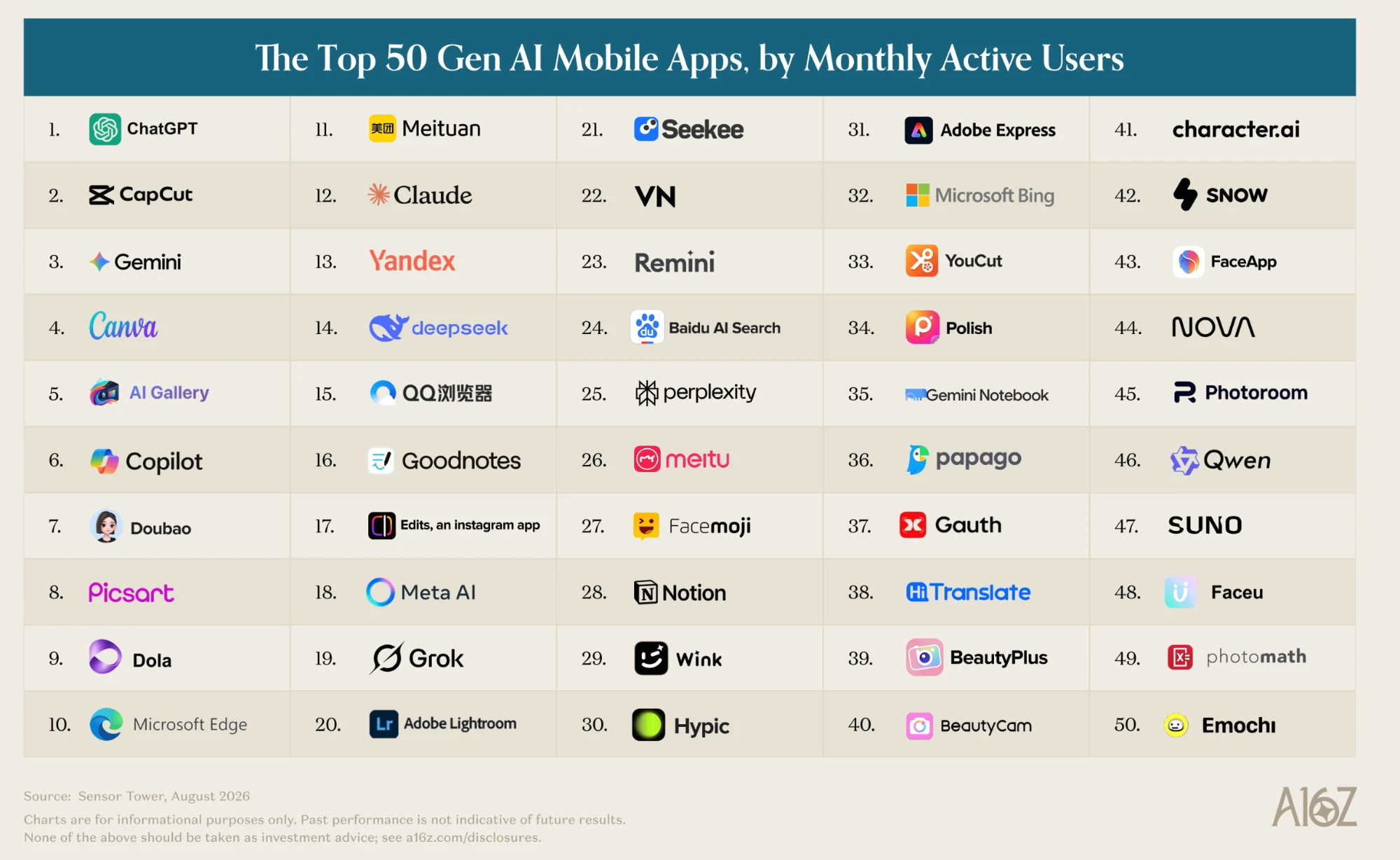
Image source: a16z, “The Top 100 Gen AI Consumer Apps — 7th Edition,” with data from Sensor Tower, August 2026. See the original at a16z.com/100-gen-ai-apps-7.
At a glance, the top three are ChatGPT, CapCut, and Gemini. No surprise there. The real information appears after sorting all 50 names into categories and then regrouping them by company.
1. Start with categories: 20 photo/video editors, 16 chat apps
I grouped the 50 apps by what users open them to do:
| Category | Count | Names |
|---|---|---|
| Photo editing, video editing, design | 20 | CapCut, Canva, AI Gallery, Picsart, Edits, Lightroom, VN, Remini, Meitu, Wink, Hypic, Adobe Express, YouCut, Polish, BeautyPlus, BeautyCam, SNOW, FaceApp, Photoroom, Faceu |
| Chat assistants, AI search, companionship | 16 | ChatGPT, Gemini, Copilot, Doubao, Dola, Claude, DeepSeek, Meta AI, Grok, Seekee, Baidu AI Search, Perplexity, character.ai, NOVA, Qwen, Emochi |
| Browsers | 4 | Microsoft Edge, Yandex, QQ Browser, Microsoft Bing |
| Notes and documents | 3 | Goodnotes, Notion, Gemini Notebook |
| Take a photo to solve a problem | 2 | Gauth, Photomath |
| Translation | 2 | Papago, HiTranslate |
| Other | 3 | Meituan, Facemoji Keyboard, Suno |
The two largest categories contain 36 apps, or more than 70%. Of the remaining 14, browsers and note apps are older products that added an AI button, while photo-based problem solving and translation are necessary categories that existed before AI.
There are fewer than 10 products in this Top 50 that were truly born because of AI and whose users came specifically for the AI: chat assistants count as one category, Suno as another, and something like Remini, which restores old photos, counts as half a category. Everything else is an old need with a new engine.
2. Regroup by company: five from ByteDance, four from Meitu
Put the apps back with the companies behind them and you get another picture:
| Company | Apps on the list |
|---|---|
| ByteDance | CapCut, Doubao, Hypic (the overseas version of Xingtu), Gauth, Faceu |
| Meitu | Meitu, Wink, BeautyPlus, BeautyCam |
| Microsoft | Copilot, Edge, Bing |
| Gemini, Gemini Notebook | |
| Meta | Meta AI, Edits |
| Adobe | Lightroom, Adobe Express |
| Naver | SNOW, Papago |
ByteDance takes five spots, and none was started as “AI native”: CapCut is Jianying taken overseas, Xingtu and Faceu are old photo-editing apps, Gauth solves problems from photos, and Doubao is the only one launched specifically for AI, ranking seventh.
Meitu is more interesting. A company whose market value is several orders of magnitude smaller than ByteDance's pushed four photo-editing apps into the global Top 50. Its task is very focused: make people look better in the camera. That need has gone from 2008 to today; AI has simply replaced the underlying generation of its filters.
I can confidently identify 14 apps from Chinese companies: CapCut, Doubao, Meituan, DeepSeek, QQ Browser, Baidu AI Search, Meitu's four-app set, Hypic, Gauth, Qwen, and Faceu. Add several editing and translation tools released overseas by teams based in China, and the share is around one-third. Chinese teams' position on this chart is mainly not models, but the photo/video-editing line, which matches the tool-product capabilities accumulated over a decade of China's mobile internet.
3. Half the list isn't AI companies; distribution matters more than models
Meituan ranks 11th, one place ahead of Claude.
This does not mean Meituan's AI is better than Anthropic's. Sensor Tower counts monthly active users of “apps with generative AI features.” Meituan put an AI assistant into its main app, so the hundreds of millions of people who open it to order food are counted. The same applies to Microsoft Edge at number 10, QQ Browser at number 15, Goodnotes at number 16, and Notion at number 28.
You can certainly criticize this measurement, but it exposes a fact perfectly: on a phone, how many people an AI feature can reach depends on which entrance it is attached to, not how powerful the model behind it is.
a16z's report gives a set of numbers: ChatGPT's mobile MAU is 2.5 times Gemini's and 14 times Claude's. On the web, the gaps are smaller, at 2 times and 6 times respectively. The same Claude is six times behind ChatGPT on the web and 14 times behind on mobile. Model capability is diluted further on phones because distribution relies on preinstallation, system entry points, and the existing user base of an app.
Claude also briefly reached number one on the US App Store's free chart this year. That was a download peak caused by a news event; by the August MAU measure, the gap was still 14 times.
4. Chat is winner-take-all, but there are people in the gaps
Of the 16 chat apps, the companies behind ChatGPT, Gemini, Copilot, Doubao, Claude, DeepSeek, Meta AI, Grok, and Qwen—the nine apps—train their own models. An independent developer's first reaction should be: stop thinking about a general chat assistant.
But the other seven deserve a closer look:
- Dola (No. 9): manages calendars through chat; users send a sentence in WhatsApp or Telegram to create an event;
- Seekee (No. 21): AI search plus a browser;
- character.ai (No. 41) and Emochi (No. 50): AI character companionship;
- NOVA (No. 44): a wrapper chat app that calls someone else's models;
- Perplexity (No. 25): AI search.
Their common point is that none directly tries to do “chat about anything.” Dola only does calendars, Emochi only does companionship, and NOVA serves people who “don't want to register for ChatGPT.” The general lane is full of model companies, but model companies are not building users' specific contexts. Dola at No. 9 and NOVA at No. 44 both prove one thing: being a wrapper is not embarrassing; what is embarrassing is putting a wrapper on something and still trying to do the same thing as ChatGPT.
Add HiTranslate for translation, Facemoji for keyboards, VN and YouCut for editing, and Polish and Remini for photo editing. Around a dozen products on this chart are backed by neither large tech companies nor model companies. Their way into the list is highly consistent: one concrete action, one concrete user group, with AI simply making that action faster and better.
5. The MAU list is not the paid list; independent developers should study the latter
This edition added a paid ranking for the first time, using YipitData's US consumer credit-card panel. Its overlap with this MAU list is shockingly low:
- Of the top 50 companies in the paid ranking, 29 appear on neither the web nor mobile traffic list;
- only seven appear on all three lists: ChatGPT, Claude, Suno, Perplexity, Photoroom, Canva, and Notion;
- 4.5% of US consumers held a paid subscription to ChatGPT, Gemini, or Claude in August, up from 2.1% a year earlier;
- the median paid user spent $25 per month, while the top 1% spent $903 per month; this 1% contributed 19.5% of consumer AI spending.
The paid ranking includes n8n, fal, Manus, Higgsfield, HeyGen, ElevenLabs, Superhuman, and Plaud. Most ordinary people have never heard of these products, but they collected real money from a small group of heavy users.
The photo/video editors on this MAU list have huge user numbers, but the a16z report also notes that consumer AI is “used broadly, used shallowly”; the vast majority of people do not pay for it. These products monetize through scale, and scale depends on distribution—the exact thing small teams have the least of. By contrast, the automation, generation, and meeting-recording products on the paid list have fewer users, but each user is willing to spend tens or hundreds of dollars per month. That is the kind of business a small team can reach.
6. Three conclusions
Putting this chart together with the body of the report, I wrote down three conclusions:
Do not build general chat or general photo editing. The former belongs to model companies; the latter belongs to ByteDance, Meitu, and Adobe. On mobile, the leading positions in these two categories will not have new entrants.
Build a specific action, not an AI category. Every non-big-tech product on the list is “one action plus AI”: translation, problem solving, calendar management, companionship, or background removal. Users search for an action, not for AI.
Find ideas in the paid list and study distribution in the MAU list. The examples of old apps adding an AI button and reaching the Top 20 show that if you already have a product with users, adding AI inside it is much more worthwhile than starting an AI product from scratch. If you have no users yet, look at the paid list to see what heavy users are paying for.
The full ranking and details of the paid list are in the a16z original: The Top 100 Gen AI Consumer Apps — 7th Edition.