You Need SOTA Models to Reach the Ceiling of AI Programming
People often ask how to use SOTA models. AMP's model-selection strategy shows the answer: max out every stage to approach the real ceiling of AI programming.
You Need SOTA Models to Reach the Ceiling of AI Programming
People often ask me: with so many models, how should we choose?
My answer is simple—use the strongest one directly.
Not “good enough”, and not “the best value”. Use the strongest model available at every stage. There is only one reason: the model you use determines where the ceiling you can touch is.
Why You Should Always Use SOTA
Many people think like this: use a small model for small tasks and a large model only for large tasks. It sounds reasonable, but there is a fatal problem—you do not know where the ceiling is until you hit it.
- With a “good enough” model, you never know what a stronger model could surprise you with
- The gap in code quality is often not “runs vs. does not run”, but “runs vs. runs elegantly”
- A SOTA model’s comprehension, reasoning depth, and context control cannot be made up for by trying a weak model “a few more times”
Only the strongest model shows you where the boundary of AI programming really is. Touch the ceiling first, then decide where compromise is possible—instead of limiting yourself from the start.
AMP’s Model Selection: Max Out Every Stage
AMP is one of the AI programming tools worth watching most closely. Its model-routing strategy is worth learning from: rather than choosing one model for everything, use the strongest model in that field for every subtask:
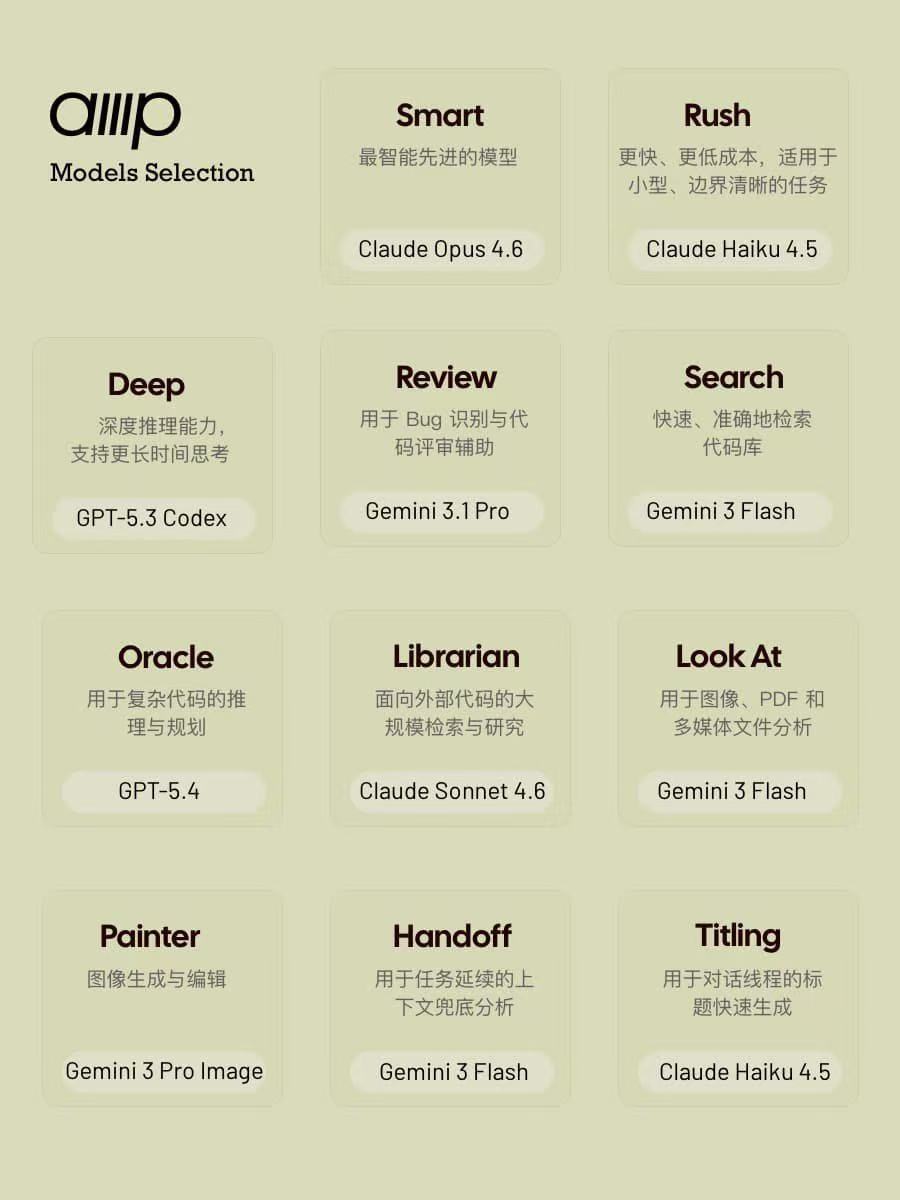
| Task | Model | Why this one |
|---|---|---|
| Smart - Most intelligent and advanced model | Claude Opus 4.6 | The current ceiling for overall capability; the first choice for complex programming tasks |
| Rush - Small, clearly bounded tasks | Claude Haiku 4.5 | Fast without being weak; light tasks do not need a cannon to kill a mosquito |
| Deep - Deep reasoning | GPT-5.3 Codex | Supports longer thinking; strongest for complex logical reasoning |
| Review - Bug finding and code review | Gemini 3.1 Pro | Stands out at code review |
| Search - Codebase search | Gemini 3 Flash | Fast and accurate; search should be fast |
| Oracle - Complex code reasoning and planning | GPT-5.4 | The newest and strongest reasoning model |
| Librarian - Large-scale external code search | Claude Sonnet 4.6 | Built for understanding and retrieving huge amounts of code |
| Look At - Image/PDF/multimedia analysis | Gemini 3 Flash | Fast and accurate multimodal processing |
| Painter - Image generation and editing | Gemini 3 Pro Image | One of the strongest image-generation models available |
| Handoff - Context analysis when continuing a task | Gemini 3 Flash | Provides contextual fallback and quick handoff |
| Titling - Conversation title generation | Claude Haiku 4.5 | Haiku is enough for a light task like generating a title |
Look closely: this is not about saving money; it is about choosing the strongest model on every dimension. If Claude is strongest at reasoning, use Claude; if GPT is strongest at deep thinking, use GPT; if Gemini is fastest at search, use Gemini. There is no platform loyalty, only the strongest model for the job.
Copy the Homework with Your Eyes Closed
If you are using an AI programming tool and do not know how to choose models, copy AMP’s configuration directly:
- Primary programming: Claude Opus 4.6 (do not save here; use the strongest)
- Deep reasoning: GPT-5.3 Codex or GPT-5.4
- Code review: Gemini 3.1 Pro
- Search and retrieval: Gemini 3 Flash
- Image-related work: Gemini 3 Pro Image
The core principle is just one: use the ceiling model for every task in its domain.
A Change in Perspective
Many people are still at the stage of “choose one model and use it for everything”. But the future of AI programming is multi-model collaboration, with the strongest model at every stage.
Do not fear the cost or switching. The upper limit of the model you use is the upper limit of your work.
Touch the ceiling first, then you will know what the ceiling looks like.